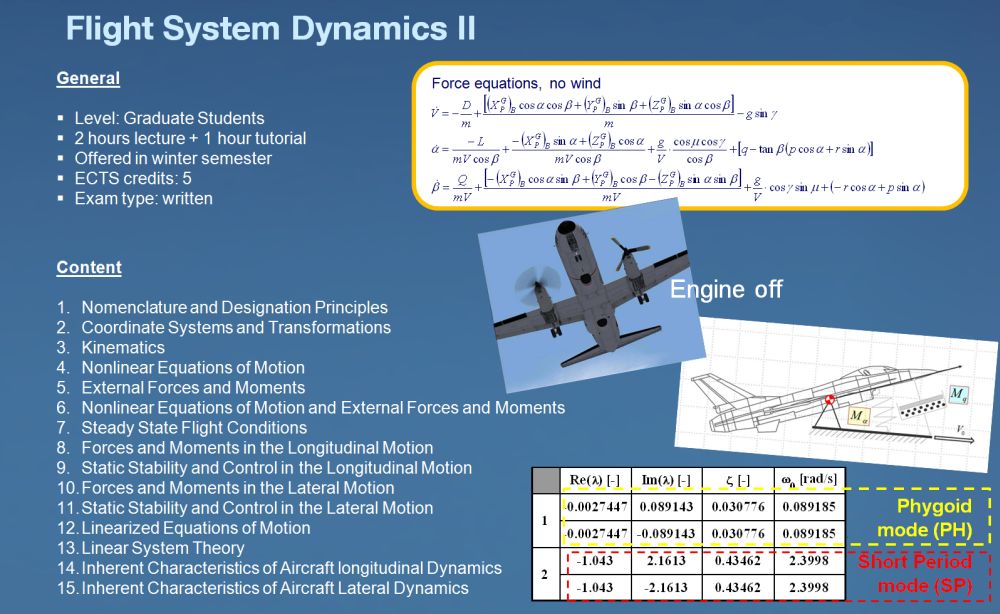
(formerly known as Flight System Dynamics 2)
| Key Facts | |
|---|---|
| Lecturer | Prof. Dr.-Ing. Florian Holzapfel |
| Contact | Jan Roggentin, M.Sc. |
| Language of Instructions | English |
| Language of Materials | English |
| Type / ECTS | Lecture, Exercise / 5 (Master Module) |
| Semester | Summer Semester |
| Time and Place | Lecture: Tuesdays, 10.00-11.30, MW0250, online (TUM-Online) Exercise: Tuesdays, 11.30-12.30, MW0250, online (TUM-Online) |
| Related Links | TUM-Online: Lecture, Exercise Moodle: Exercise |
| Details | |
|---|---|
| Prerequisites | One of the following modules: |
| Content / Educational Objectives |
This lecture provides an in-depth introduction to aircraft flight dynamics, stability, and control. Starting from coordinate systems, reference frames, and kinematic relationships, the course develops the mathematical foundations required to describe aircraft translation, rotation, attitude, and position. Based on the principles of rigid-body mechanics, the nonlinear equations of motion are derived and formulated. The underlying models for aerodynamic, gravitational, and propulsion-induced forces and moments are introduced. The course further examines equilibrium flight conditions and trim analysis for level flight, climbing flight, coordinated turns, and pull-up maneuvers. Particular emphasis is placed on the longitudinal and lateral-directional dynamics of aircraft. Topics include static and dynamic stability, controllability, and handling characteristics, as well as the aerodynamic mechanisms governing these properties. In the longitudinal case, concepts such as the neutral point, maneuver point, trim conditions, elevator effectiveness, hinge moments, stick-fixed and stick-free stability, control forces, and longitudinal handling qualities are investigated. Lateral-directional topics include weathercock stability, dihedral and sweep effects, roll and yaw damping, rudder and aileron control effectiveness, and the consequences of asymmetric thrust conditions. Finally, the nonlinear equations of motion are linearized about representative trim conditions to obtain mathematical models suitable for dynamic analysis. These models are used to investigate the characteristic motion of aircraft and the physical mechanisms governing the short-period, phugoid, roll, Dutch-roll, and spiral modes. The lecture establishes the theoretical foundations required for the analysis, design, and assessment of aircraft stability, controllability, and handling qualities. Upon completion of this course, students will be able to formulate and interpret nonlinear equations of motion, model aerodynamic and external forces and moments, analyze trim and stability characteristics, derive linearized aircraft models, and assess the dynamic behavior and controllability of aircraft using modern system-theoretic methods. |
| Exam | Exam in two parts:
|
| Reference Literature |
|